
Thinking Back on CAPP—Alumni Voices
Having the opportunity to serve on the Contemporary Art Purchasing Program with fellow classmates was one of the highlights of my college experience. CAPP not only enforced teachings and lessons learned in my art history courses, but also taught valuable leadership, communication, and collaboration skills. I am so grateful to have been a part of such an impactful program where we focused on highlighting and elevating our Terp community, while also being able to leave my permanent stamp (pun intended) at the University.
Katherine (Jackson) Eastman, 2020-2021 CAPP Committee
Lindsay Smilow, 2006–2007 CAPP Committee
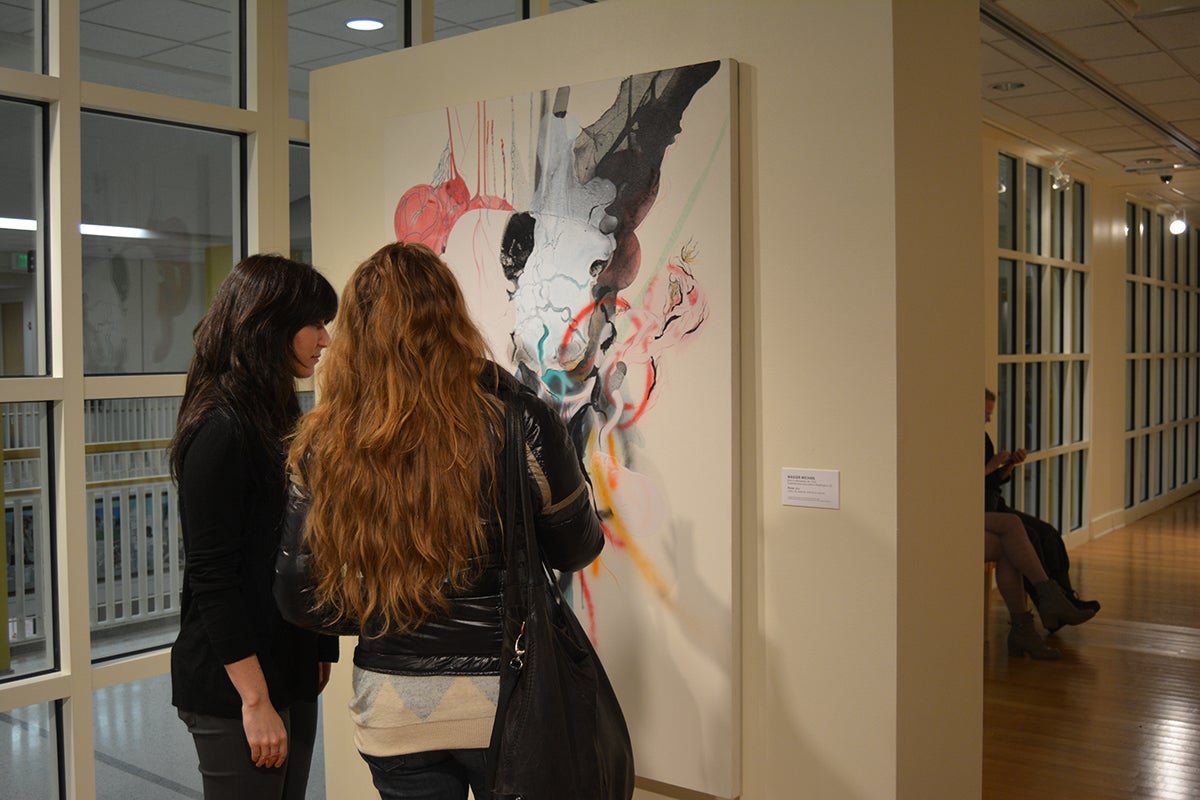
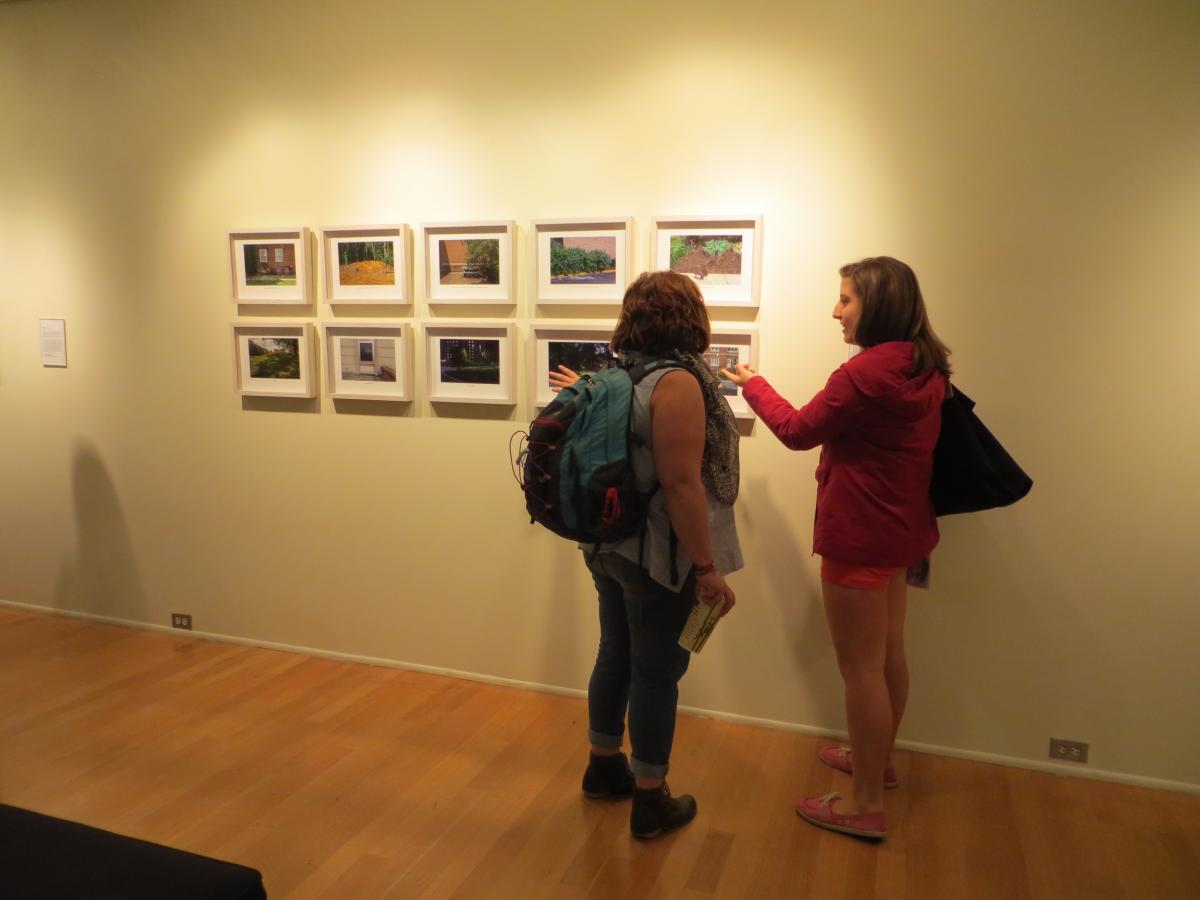
Lindsay Smilow and the artist Maggie Michael examine Michael's painting Throw (2006), acquired by the 2006-07 CAPP committee. Photo: Christopher Bugtong.
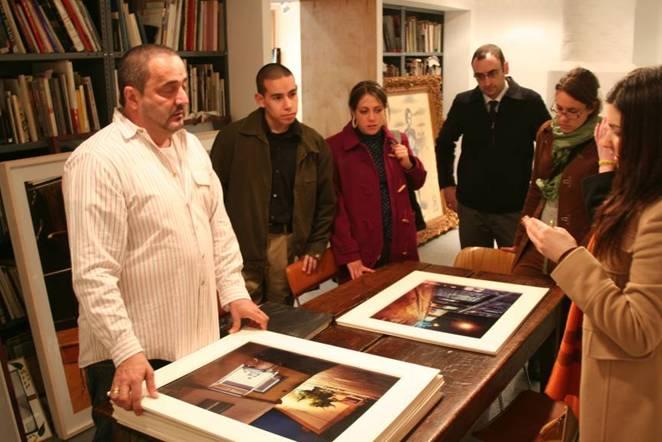
March 2007. Chasing art around New York; waiting in the back room of Leslie Tonkonow's second floor space; invited to the basement of Jack Shainman on 24th street; looking through Yossi Milo's flat files; getting lost en route to a studio visit in Brooklyn; surrounded by prints at Pace on 57th; rounded out by a visit to the Whitney Museum to catch Lorna Simpson’s retrospective. The images I had come to know from textbooks, computer screens, and powerpoint presentations were springing to life in real time as six college students were taken as seriously as any other art collectors by world-reknowned dealers. We came researched, with money to spend, and a list of art to acquire. I can still see Leslie Tonkonow smiling as we flipped through the pages of Nikki S. Lee’s "Projects" (1997–2001), thumbnails on paper with names of the various institutions that had already purchased photographs. Only a handful of artist’s proofs were still available for the University of Maryland art collection we were about to build.
The progam’s first acquisitions, mostly photography, a bit of painting, and that home-run Lorna Simpson print + sound piece, really spoke to each and every student that comprised the group. Decisions were always unanimous, or at least they ended up that way. Much of the work purchased in my inaugural year was concerned with identity and perception; I now understand why those themes spoke volumes to 21-year-old art buyers. Often, I play the would've, should've, could've game with our strategy. But then again, that risk and effort, teaching the theory of the art market and collecting by allowing students to decide what lives at their alma mater for years to come, yielded a collection that reflects each group’s moment in time.
January 2016. I can plainly see how this unprecedented process has informed my career in more ways than I can count.
Lindsay Smilow, UMD '07
2006–2007 CAPP Committee
Alison Reilly, 2008–2009 CAPP Committee
The summer before I joined the Contemporary Art Purchasing Program (CAPP) I interned at a gallery in New York so I had some exposure to the intricacies of the art world, but CAPP gave me an opportunity to be on the other side of the decision-making process. While a few galleries were apprehensive about a group of five students from Maryland, most of the gallery directors warmly welcomed us into their spaces and understood that we had real purchasing power. As a committee member, I gained practical negotiation and collaboration skills in order to present my selections for the collection to other committee members and our advisory board.
I was particularly interested in Edward Burtynsky’s work because of his stunning documentation of the effects of human and industrial intervention on the land. His gallery in New York ended up closing while we were negotiating with them, but we were still able to purchase his photograph Silver Lake Operations #1, Lake Lefroy, Western Australia, 2007, which I am thrilled to have in the Stamp Collection. Artist Dulce Pinzón also invited us into her studio in Brooklyn, which was really the first time I visited an artist’s studio. We purchased two of her photographs from the series "The real story of Superheroes," which questions the recognition of immigrants in the United States and remains as socially relevant now as it was in 2009.
CAPP was one of the most significant experiences for me as an undergraduate student because I was invested from start to finish – from the initial artist research to finally seeing the work hanging on the walls of the Stamp Student Union. I’m very proud of the work that I did with Sana Javed, Ophra Paul, Ali Steubner, and Megan Wickless, with the support of our advisors, Jackie Milad and Megan Rook-Koepsel.
Alison Reilly, UMD '09
2008–2009 CAPP Committee
Eldis Sula, 2010–2011 CAPP Committee
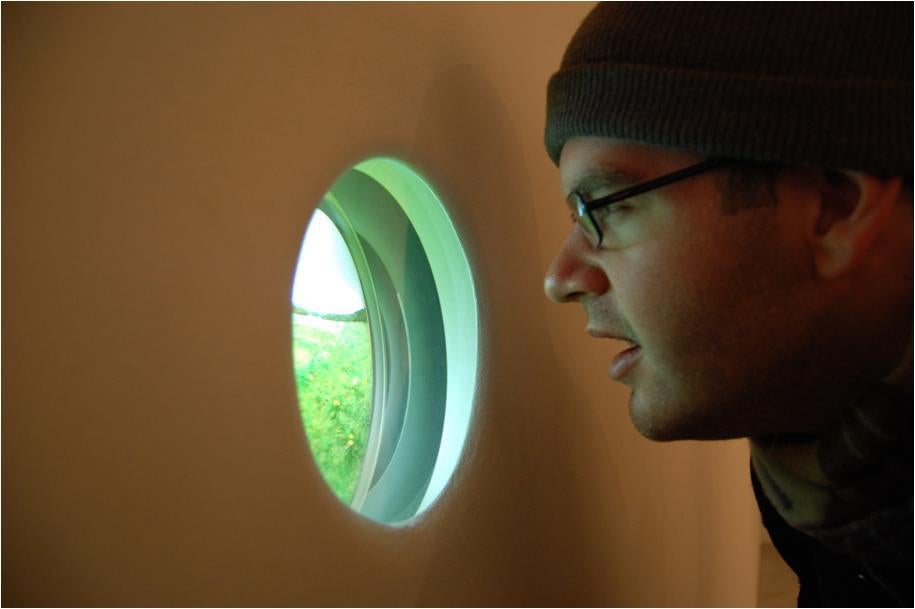
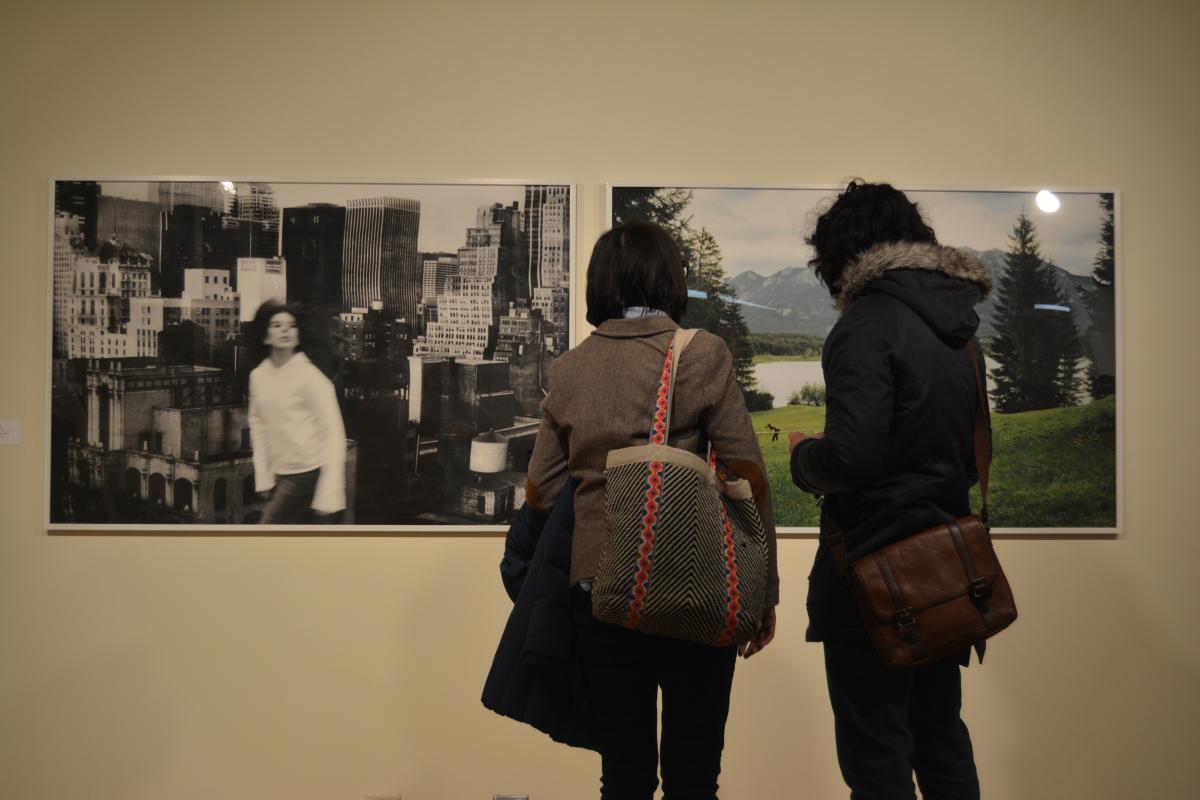
Eldis Sula looks into Patrick Jacobs's Fairy Ring with White Clover (2010) acquired by his committee in 2011. Photo courtesy of Eldis Sula.
The Contemporary Art Purchasing Program is a terribly important initiative at the University of Maryland. CAPP was one of the best projects that I've been involved in, as a student in college, and in my life in general. It was thrilling to dive head-first into the contemporary art world, to hear Jenny Morgan discuss her creative process at her studio in Brooklyn, or to gaze deeply into Patrick Jacobs's intricate dream-like diorama at Pierogi Gallery, not to mention the more than 30 other incredible artists and galleries we visited in New York and DC, and the hundreds of paintings and sculptures that we considered in the process.
As a committee member, I was afforded the rare opportunity to take part in something I am passionate about – looking at and thinking about art – while also being involved in the practical, real-world applications of the art market that I would have never been exposed to otherwise – that is, operating within a budget, serving as a representative of the University of Maryland, and making critical decisions about how to best engage the university community and make art come alive within the Stamp Student Union.
Looking back on the program now, I’m astounded by the tremendous responsibility that was bestowed upon our student committee. But after reflecting on the experience, why should I, or anyone, be surprised? At its basis, CAPP operates on the convictions that art is important, that it improves our quality of life, and that its mere presence can awaken our consciousness, regardless of background or age. This is why the program – which elects a multi-faceted group of students, guided by a critical advisory board, in order to represent a diverse student body – has been a success for the ten years of its existence before, during, and since I’ve been involved, and will continue to be so for years to come.
Eldis Sula, UMD '11
2010–2011 CAPP Committee
Hannah Kelly, 2012–2013 CAPP Committee
The Contemporary Art Purchasing Program was one of the most rewarding programs I participated in during my time at the University of Maryland. I was studying abroad in London when I got the email from the Art History department requesting applications for the program and realized that it was a once in a life time experience. I was excited to be able to purchase art that would be on display at my alma mater for years to come. I liked the idea of leaving my mark on a place that had so thoroughly changed my life. There were times when I thought my head would explode due to an overload of art, but I learned so much from the artists and from my fellow committee members. While it was terribly hard to narrow down our selection from roughly 100 artists to eight, this program taught me to be decisive, to compromise, and to negotiate.
Hannah Kelly, UMD '13
2012–2013 CAPP Committee
Zulekha Sayyed, 2012–2013 CAPP Committee
The committee for the Contemporary Art Purchase Program 2012–2013 consisted of people from diverse backgrounds and experiences. Our job as a committee was to come together and bring art to the campus community. Not only to students, but also to those who work and visit the campus. Our process began by outlining the goals of our committee. We saw ourselves as the representatives of the student body, and felt that our job was to choose artworks that would be especially meaningful to those who would be interacting with it every day. We wanted the work to connect to the everyday lives of students by addressing the pressing issues facing our generation. In doing so, we would add to the timeline that previous committees had begun for us. We strove to find work that speaks to the diversity of our community. We recognized the perspective of the artist as context for a given work of art, and focused on choosing works from artists of diverse backgrounds as well. As a state college, we felt it was important to support emerging artists in and around Maryland. We wanted to make sure that the work we chose was innovative and unconventional in the fast changing realm of contemporary art. We wanted works that pushed the limits in terms of subject matter, processes, and mediums.
We tackled our challenge by thinking within a curatorial frame of mind. The works we chose should not only speak to our audience, but also be a significant addition to the collection as a whole. We built upon the themes already present within the collection, including culture, race, environmentalism, and process-oriented works. To this conversation, our committee added works that have a broader social and political outlook. Our process included research on contemporary art trends and artists from all around the world. Throughout the year, we met with artists and visited galleries in Baltimore, Washington DC, and New York. We were aided in our process by a class on art markets and collecting taken during the fall semester. We also had the feedback and advice of an advisory board made up of artists, administrators, collectors, and former committee members. After many months of research, travel, and deliberation, we hope that we have done well in presenting art that will be impactful and exciting for many years to come. We hope that when you view the collection you will find a place for yourself, a place to reflect, and a place to be inspired.
Zulekha Sayyed, UMD '13
2012–2013 CAPP Committee